Clearing the smoke: 50 years of nicotine dependence treatment, research, education and advocacy at Mayo Clinic
Richard Hurt, M.D. (I ’76), smoked in medical school, as did two other students in his gross anatomy dissection group. Their cadaver had died with emphysema, but this did not concern them. Instead, they laughingly declared that emphysema would never happen to them.
At the time, Dr. Hurt smoked two to three packs a day. He had tried to quit dozens of times, lasting half a day at most. And yet, he didn’t con- sider himself addicted to cigarettes.
Most physicians at the time wouldn’t have considered him addicted, either. The medical establishment tended to view smoking as a habit that could be ended with willpower — a message promoted aggressively by the tobacco industry.
“There was a huge public relations campaign that was going on from the 1960s, and it’s still going on today, to say it really is just a matter of choice. People choose to smoke. People choose not to smoke. What’s the big deal?” Dr. Hurt says.
Dr. Hurt’s perspective didn’t shift until 1975, when he was a resident at Mayo Clinic and his wife signed them up for the newly opened Smokers’ Clinic, a joint effort between Rochester Methodist Hospital and Mayo Clinic. The program, founded by pioneering Mayo Clinic pulmonologist Norman Hepper, M.D. (I ’55, died 2022), consisted of medical lectures and small-group discussion. With the clinic’s help, Dr. Hurt successfully stopped smoking at week four. He then attended a panel of former smokers at the clinic. Dr. Hurt asked the panel a question: How would he cope if his wife started smoking again?
“(The panelist) was very direct. He looked me straight in the eye and said, ‘You’re setting yourself up to start smoking again, aren’t you?’” Dr. Hurt says. “It just resonated with what I knew about relapse and other addictions. That was the turning point. I said to myself, well, this is really no different than people who are addicted to alcohol and other drugs.”
This reframing sent Dr. Hurt on an “entirely different journey,” he says. He realized he’d been in denial about the harm of cigarettes, rationalizing his use, forming rituals around smoking — in short, displaying many of the behaviors he’d seen when rotating in the alcoholism treatment unit.
“Once you realize the drug has taken control, then the recovery process becomes very obvious,” Dr. Hurt says.
His belief that smoking was an addiction — and should be treated like one — grew throughout his involvement with the Smokers’ Clinic. After graduating from the program, he returned as a group leader and eventually became its medical director.
In group sessions at the Smokers’ Clinic, Dr. Hurt heard echoes of the group discussions he’d witnessed in the alcoholism treatment unit. Like alcohol, smoking was like a friend; it helped them cope or relax. People addicted to alcohol could be shown concerning liver tests and deny drinking was hurting them; smokers would brush off their constant, hacking cough as an unrelated phenomenon.
So Dr. Hurt began giving lectures on addiction concepts like tolerance, rationalization, denial and withdrawal in the Smokers’ Clinic, and found these resonated with the smoking audience.
But eventually, it was clear that this wasn’t enough. Dr. Hurt distinctly remembers getting two phone calls from Mayo Clinic colleagues on the same day in 1986: one from dermatology and one from vascular medicine. Both were calling about patients who had ischemic ulcers in the lower extremities — and were continuing to smoke. What could be done for these patients?
“The answer was nothing,” Dr. Hurt says. “The Smokers’ Clinic was an outpatient clinic. There was an outpatient, 90-minute patient education program, but it really wasn’t very intensive. And so there was nothing we could do. This is back in the days when we could do a heart transplant, but we couldn’t help people stop smoking, even though they clearly needed it.”
That day, Dr. Hurt met with Mayo Clinic biostatistics professor Kenneth Offord and the pair decided something had to be done to fill this gap in clinical care. With their colleagues, they would work to found the Nicotine Dependence Center, a program that would go on to affect clinical practice, education and research in ways that are “hard to even imagine,” Dr. Hurt says.
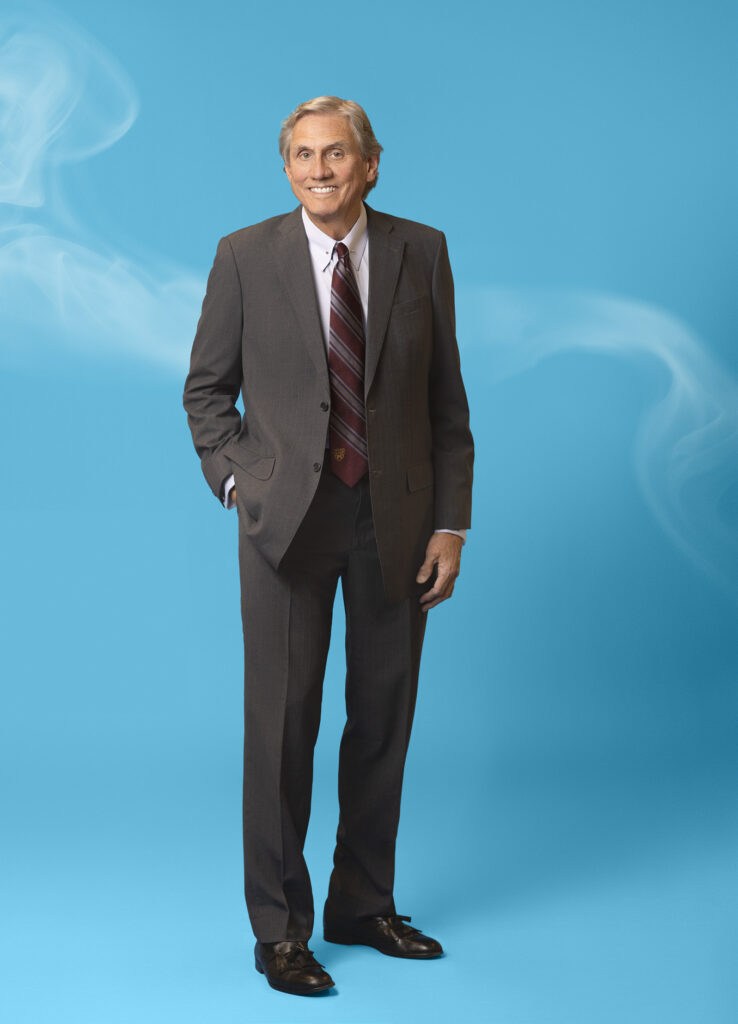
“ We could do a heart transplant, but we couldn’t help people stop smoking, even though they clearly needed it.”
– Richard Hurt, M.D.
THE NICOTINE DEPENDENCE CENTER
Dr. Hurt, Mr. Offord and an ad hoc team of colleagues knew they were swimming against cultural tides in their quest to open a Mayo Clinic nicotine dependence center and, eventually, incorporate residential treatment. Smoking was prevalent and often viewed as habitual rather than addictive, and the team knew of only one other residential treatment program for smoking offered by a medical center in the U.S.
In addition, there was a mountain of administrative work to be done. A proposal for a center had to be written and approved, the program needed to find an administrative home, and space and staffing had to be secured.
But the team persevered, and the center opened in 1988 as the Smoking Cessation Center, later renamed the Nicotine Dependence Center. It followed an addictions treatment model of counselor-provided treatment under the supervision of a physician and incorporated behavioral treatment, addictions treatment, relapse prevention and pharmacotherapy.
The NDC has continued this work for decades, and as of April 2025, had provided initial counseling to more than 66,000 people. In 1991, the center established its residential treatment program known as the Intensive Tobacco Treatment Program (ITTP), a five-day immersive recovery experience including a customized treatment plan, medications and nicotine replacement therapies. It has since served more than 2,000 patients. The NDC is now working to expand digital treatment options and is already delivering telecare to patients in Minnesota, Wisconsin, Florida and Arizona.
The center also made huge strides in researching pharmaceutical treatments for nicotine dependence. When the NDC first opened, prescription nicotine gum was the only FDA-approved drug to help smokers quit.
In 1988, the NDC initiated the first randomized, double-blind, placebo-controlled nicotine patch trial in smokers in the U.S. Since then, the center has conducted clinical trials on all other forms of nicotine replacement, as well as bupropion and varenicline as treatments for smoking and smokeless tobacco use. These studies “set the tone for treating tobacco dependence as the serious problem it is,” says Dr. Hurt, and established the NDC as a leader in intensive treatment of tobacco dependence.
Current NDC medical director Jon Ebbert, M.D. (I ’99, CMR ’00, ADGM ’01, CLRSH ’01), says researching medications remains a priority, with more innovative therapies for tobacco and nicotine dependence in the pipeline.
“We only have three FDA-approved classes of medications for the treatment of tobacco dependence, and tobacco continues to kill about 480,000 people each year in this country,” Dr. Ebbert says. “So we’re always interested in opportunities to develop new and innovative therapies.”
In the realm of education, the NDC created a Tobacco Treatment Specialist training program in 2005 that has since trained and certified more than 4,000 healthcare professionals. The center also established the Global Bridges Program to advance evidence-based tobacco dependence treatment and advocate for effective tobacco policy worldwide. Global Bridges has since expanded beyond tobacco to additional clinical areas and, as of August 2025, had directed more than $15 million in grant support to 112 independent medical education projects, training 54,000 healthcare professionals in 85 countries.
In addition to this impressive education, research and clinical work, in 1998 Dr. Hurt participated in one of the most pivotal legal cases against the tobacco industry in the U.S.
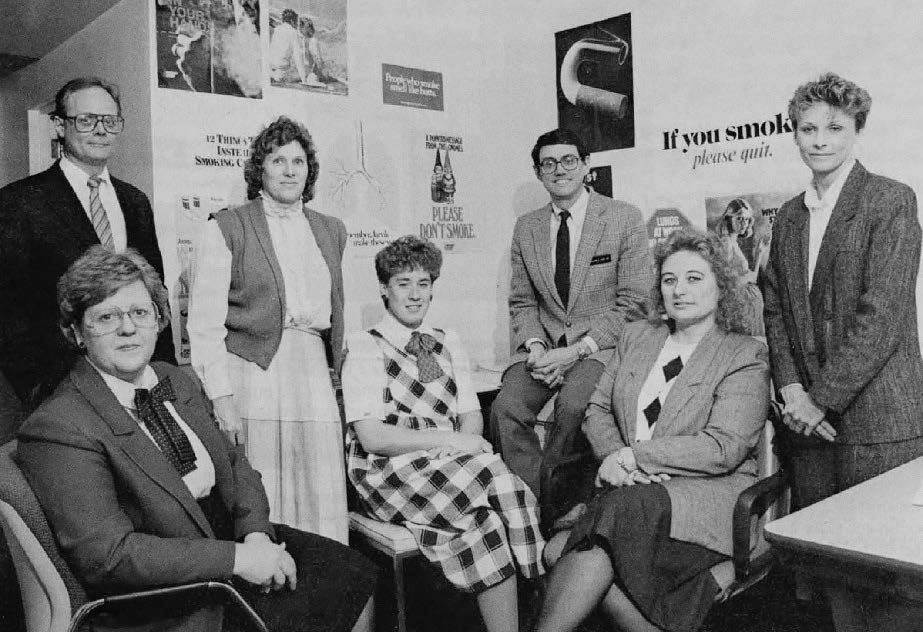
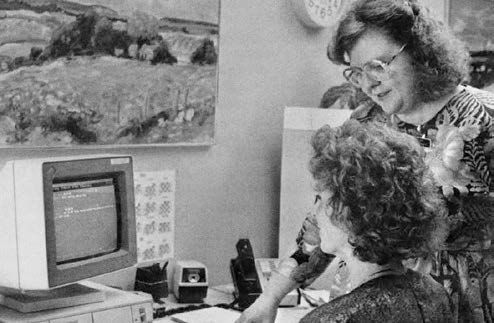
Top: Staff members of the newly opened Mayo Clinic Smoking Cessation Center, which would later be renamed the Nicotine Dependence Center (NDC), in 1988. Staff members included, from left, front row: Frances McClain, Karen Hurtis and Kathryn Hart; back row: Gary Lauger, Kay Eberman, Program Director Richard Hurt, M.D., and Luanne Schmidt. Right: Luanne Schmidt and Frances McClain discuss follow-up communication to an NDC patient.
THE TOBACCO TRIAL
In the early 1990s, Minnesota was one of four states trying to hold the tobacco industry accountable through legal action. History was not on their side; the hundreds of cases that had been filed against the industry since 1950 had been overwhelmingly unsuccessful.
But the Minnesota attorney general and Blue Cross and Blue Shield of Minnesota sued the tobacco industry in 1994 using different legal strategies. The state argued that by manipulating nicotine content and engaging in false advertising, the industry had violated consumer protection and antitrust laws. The health insurance company Blue Cross and Blue Shield argued that cigarette use was sickening their customers and sued to recoup the costs of increased insurance claims.
To bolster their argument, the state asked Dr. Hurt to appear as an expert witness to help prove that cigarette manufacturers had manipulated cigarettes and deceived consumers.
“The lawyers came down to meet with me, and said, ‘We’re going to learn from you. You’re going to teach us about addictions and then we’re going to teach you about the Looney Tunes of lawyering,’” Dr. Hurt says.
Dr. Hurt spent the next two years sifting through selections of 33 million pages of previously secret tobacco industry documents. The World Health Organization would later write: “The idea — what lawyers call ‘papering’ — was to simply bury the relevant material in a lot of trash. They forgot that winters are long in Minnesota and did not realize that the Minnesota team would look through all the paper.”
Within this avalanche of documents, Dr. Hurt and the state’s team made damning discoveries. The documents showed that the tobacco industry not only knew for decades that tobacco was addictive and harmful but worked to make cigarettes even more addictive and deceived consumers about cigarettes’ negative effects.
During his four and a half days on the witness stand, Dr. Hurt explained that cigarette manufacturers had been adding ammonia to cigarettes to alter the pH of the tobacco. This increased the speed of nicotine absorption and, subsequently, the addictive potential of the cigarettes. The technique, known as freebasing, was first discovered by Marlboro.
“The secret of Marlboro back in the 1960s was not the theme from The Magnificent Seven. It wasn’t the cowboys on television; it was simple chemistry,” says Dr. Hurt. “They were freebasing nicotine before the drug culture knew how to freebase cocaine.”
During the trial, Dr. Hurt also showed the deceit behind the tobacco industry’s “healthier” alternatives such as low-tar, low-nicotine cigarettes.
To prove his point, Dr. Hurt pulled out his Swiss army knife to dissect cigarettes in front of the jury. He sliced open a Marlboro Lights cigarette (advertised as a low-tar, low-nicotine option) and a Marlboro Red (the original cigarette). Both cigarettes contained the same blend and amount of tobacco. The only difference, Dr. Hurt explained, was that the “low-tar” option had double the number of ventilation holes in the tipping paper — which introduced more air into the flow of smoke, making the smoke less dense and tricking the Federal Trade Commission’s measurement machines into classifying the cigarettes as “low-tar.”
This information wasn’t just incriminating evidence for the trial; it was helpful for Dr. Hurt’s patients.
“I used that knowledge to help break through some of their own denial and their own rationalization,” he says. “It also made them a little bit angry. But they weren’t angry at themselves anymore, because they knew that they’d been manipulated all this time.”
In the end, the trial resulted in a $6.6 billion settlement to be paid by the tobacco industry. It would be followed by a 46-state settlement with tobacco companies in November 1998, which promoted tobacco control nationally and funded a new anti-tobacco nonprofit called the American Legacy Foundation.
But Dr. Hurt believes the greatest victory of the trial was the deluge of industry documents that tobacco companies were forced to release to a Minnesota depository — both at the time of the trial and, per the settlement, any future discovery in tobacco litigation for the next 10 years. The documents exposed the actions of the tobacco industry, motivating new legislation and public health policy in the U.S. and abroad, including the WHO Framework Convention on Tobacco Control (FCTC), an international treaty ratified by more than 180 countries.
“The legacy of the Minnesota tobacco trial is the release of millions of pages of documents,” says Dr. Hurt. “Those documents literally changed the world.”

announcing Mayo Clinic’s smoke-free policy, which was initially implemented in 1987; A 1998 article from the St. Paul Pioneer Press announcing the historic settlement of the Minnesota tobacco trial; A chart from a Nicotine Dependence Center study showing significant smoking cessation rates in the first randomized, double-blind, placebo-controlled nicotine patch trial in the U.S.; A 1975 article from the Mayo Clinic newspaper Mayovox announcing the opening of the Smokers’ Clinic, a joint effort between Rochester Methodist Hospital and Mayo Clinic.
HELPING PEOPLE CHANGE
Despite fighting uphill legal, logistical and cultural battles, Dr. Hurt and the NDC contributed to huge strides in the prevention and treatment of nicotine dependence.
And yet, Dr. Hurt and Dr. Ebbert know there is much more work to be done, as hundreds of thousands of Americans continue to die from tobacco-related disease every year. Despite historically low smoking rates in the U.S., Dr. Ebbert says, the country’s nicotine dependence problem may be just as bad as ever.
“The tobacco companies are still in the nicotine dependence business. So they’re continuing to drive that market with new and ever-evolving products,” like electronic cigarettes and nicotine pouches, Dr. Ebbert says.
These products avoid some of the risks of conventional cigarettes but still deliver nicotine and are still addictive. Dr. Ebbert has seen an increasing number of e-cigarette users at the NDC, and he wouldn’t be surprised to see an influx of nicotine pouch users in a few years. In the meantime, the NDC will continue researching, educating and providing clinical care to loosen tobacco’s grip on people across the U.S.
“We’re in the business of helping people change and become independent from nicotine,” says Dr. Ebbert. “When they’re ready to quit, we’re here.”
This story appears in the latest issue of Mayo Clinic Alumni magazine. You can read or download a PDF of the issue here.
Mayo Clinic alumni are entitled to the print version of the quarterly magazine. If you’re not receiving the magazine, register or log in to your online MCAA profile to make sure your address is correctly entered. Or contact the Alumni Association at mayoalumni@mayo.edu or 507-284-2317 for help.
Photography credits:
Cigarette extinguished: Lisa Predko
Richard Hurt, M.D.: Jeanna Duerscherl
All historical images and documents: Mayo Clinic Archives
Cigarette: Lisa Predko
Jon Ebbert, M.D.: Jeanna Duerscherl
Photo still life: Tony Pagel