Resident’s prosthetic sensor aims to help others like him.
Hamaad Khan, D.O. (I ’25, PMR ’28), has an idea that can significantly improve the quality of life for people who need prosthetic devices. Dr. Khan didn’t set out to be an innovator, but his firsthand experience wearing a prosthetic has propelled him to become one. His goal is to develop sensor technology to help fit amputees to their prosthetic limbs with precision.
Pairing with prosthetics
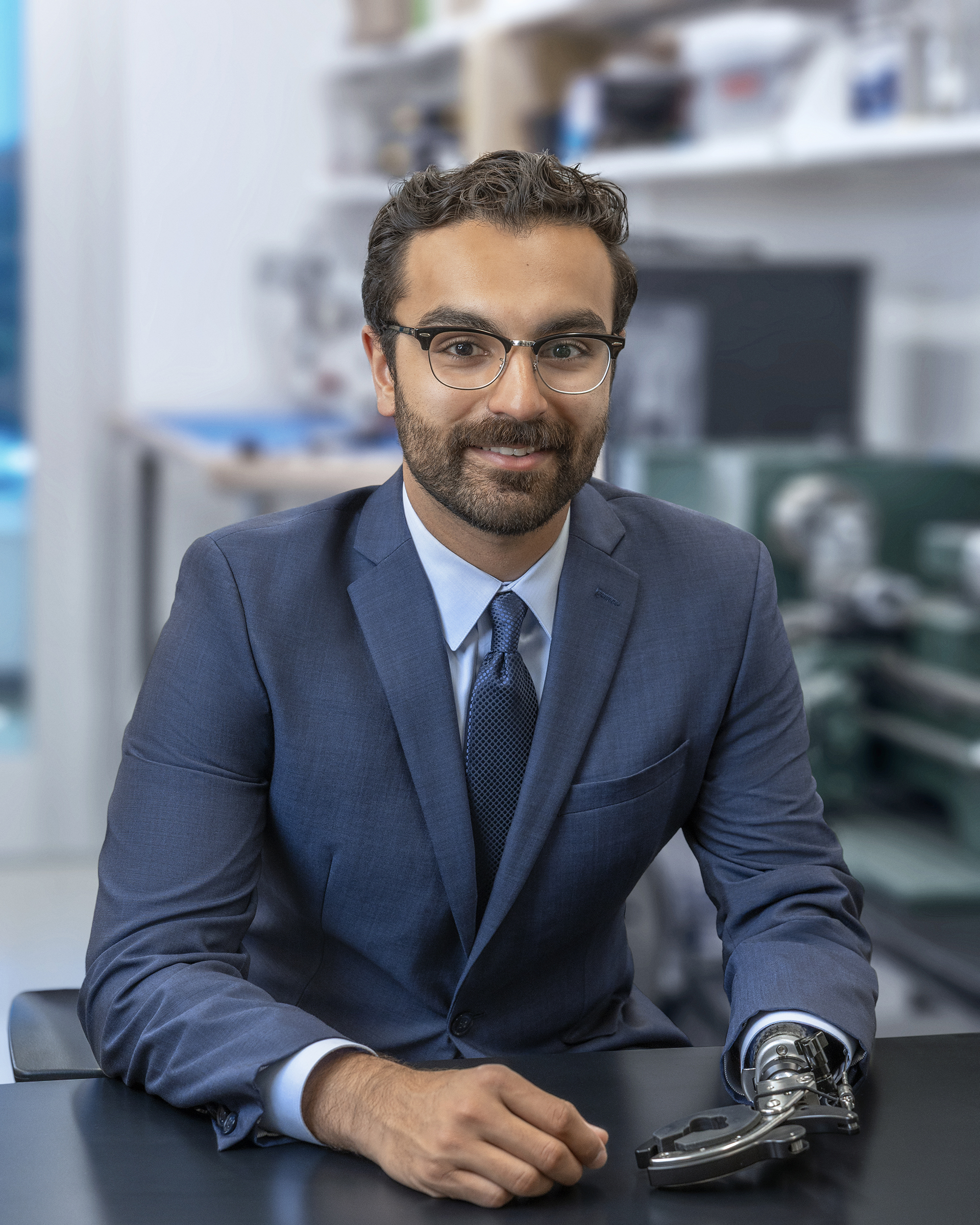
Dr. Khan is a resident at Mayo Clinic School of Graduate Medical Education in Florida specializing in Physical Medicine and Rehabilitation. He also is one of 1.7 million people in the U.S. using a prosthetic limb due to limb loss. He was born in New York with only a partial left arm due to amniotic band syndrome, a condition he experienced while in the womb. He has worn prosthetics since he was three months old. But that hasn’t slowed him down any.
Initially, he was fitted with a cosmetic prosthetic, which resembles a hand but does not function like one. He required a new prosthetic arm every time he outgrew the previous one. By the time he was 17, he had worn nearly 20 prostheses, each one taking several weeks of fitting and sizing before he could use it.
It wasn’t until Dr. Khan was 17 and interested in becoming an emergency medicine technician (EMT) that he realized that he would need more function in his arm to be able to perform the tasks required in that role.
“I realized very quickly that I was going to need a bit more function to tie knots or open IV bags,” he says.
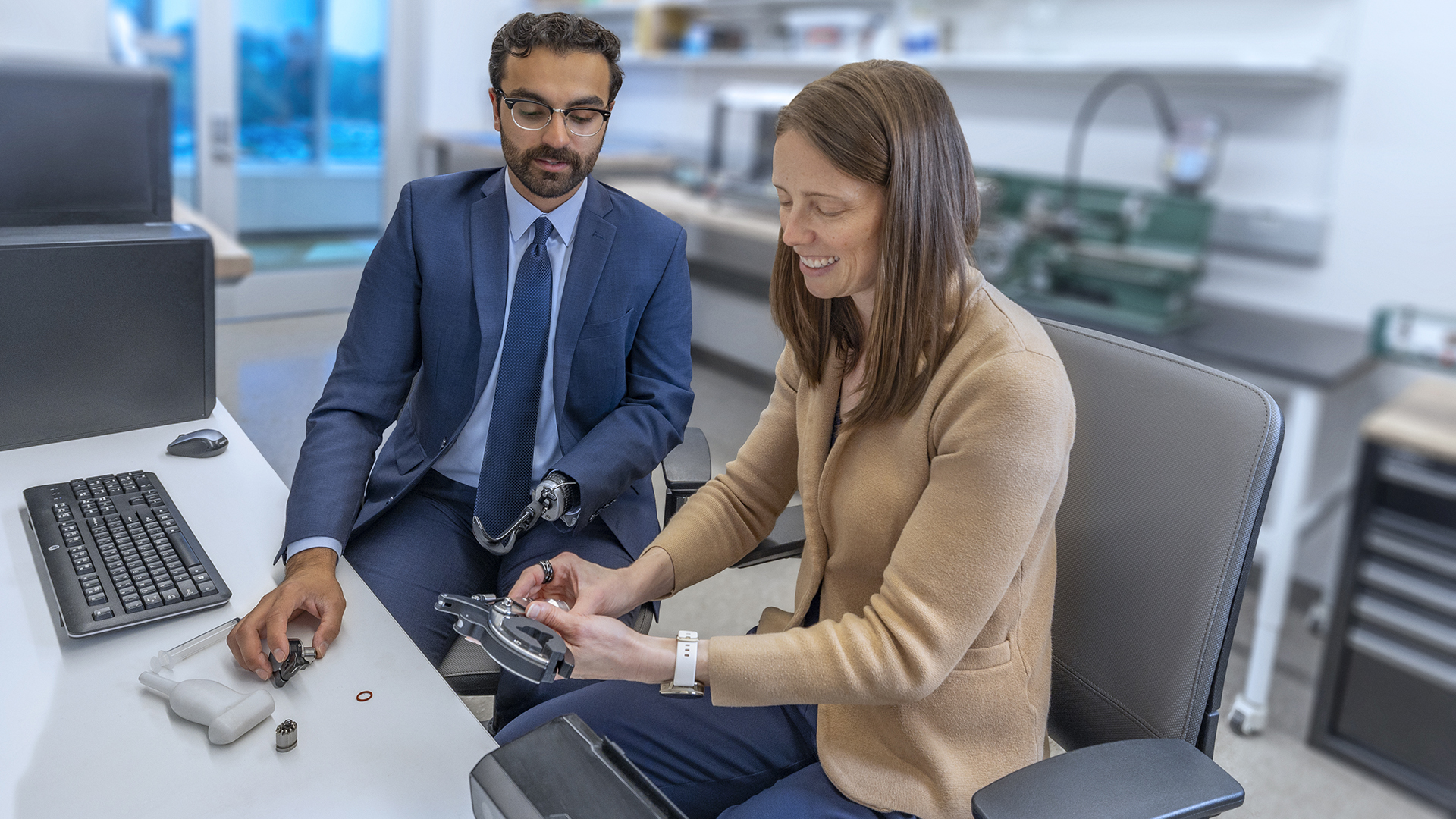
Dr. Khan consulted his prosthetist who fitted him with a body-powered prosthesis, which gave him greater functionality. He can operate the prosthesis by pulling on the cable, which opens and closes a device at the end of his arm, allowing him to grasp objects with a fine motor capability that he hadn’t had until then. He not only completed his EMT training but went on to lead his university’s volunteer EMT service while still an undergraduate student.
Answering the call
The joy of taking care of people had taken hold of him.
“It was my first introduction to medicine, and I was surprised that I enjoyed it,” Dr. Khan says. “You see people in a pretty bad situation, and you can help them pretty quickly.”
A career in medicine seemed like the next logical step, but he wasn’t entirely sure which field he wanted to pursue. Participating in a research study changed all that. Dr. Khan was part of a national study on evaluating how upper extremity amputees use their prostheses to complete complex tasks. By this time, through trial, failure and practice, he had learned to use his prosthesis well and was part of a standardized evaluation on how patients fare with them.
He performed several tasks including tying a knot and using a key. Observing him from a corner was F. Clay Smither, M.D. (MED ’15, PMR ’19), who was doing a limb loss fellowship at the Richmond Veterans Association at the time.
Dr. Smither is now the chair of Physical Medicine and Rehabilitation at Mayo Clinic in Rochester. Dr. Khan talked to Dr. Smither about his medical career aspirations and mentioned that he wanted to help amputees but wasn’t sure where to focus. Dr. Smither introduced him to the world of Physical Medicine and Rehabilitation and encouraged him to pursue that.
Dr. Khan went on to complete his medical school training at Lake Erie College of Osteopathic Medicine in Bradenton, Florida, and took a Physical Medicine and Rehabilitation elective at Brooks Rehabilitation in Jacksonville, Florida.
“It confirmed that this is some thing I really feel a passion for,” Dr. Khan says.
From there, he matched into the Physical Medicine and Rehabilitation residency program at Mayo Clinic in Florida, making him part of the first class of residents to graduate from the program. While Mayo Clinic in Rochester has one of the longest-standing Physical Medicine and Rehabilitation programs in the country, Mayo Clinic in Florida welcomed its inaugural class of Physical Medicine and Rehabilitation residents in 2024.
Searching for the proper fit
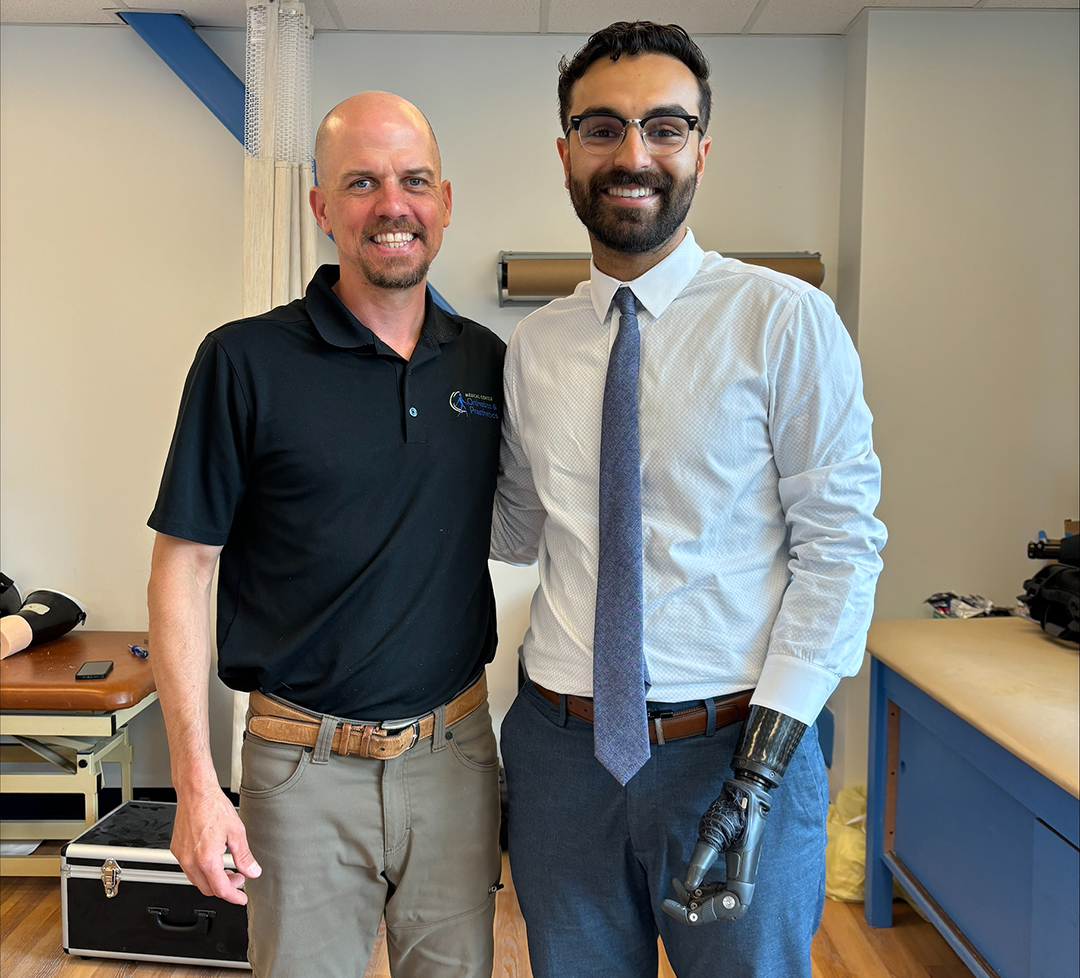
When Dr. Khan arrived in Florida for medical school, it was right in the middle of the COVID-19 pandemic. He had been fitted with a myoelectric prosthesis, an externally powered artificial limb that uses electrical signals from his own muscles to control its movements. Sensors detect muscle contractions in the residual limb and translate them into commands providing functionality for tasks such as grasping and holding objects with greater precision and a more lifelike range of motion. Dr. Khan was having trouble controlling the movement in his hand, but he wasn’t sure why.
With the world at a standstill because of COVID-19, Dr. Khan was communicating virtually with his prosthetist in Virginia to figure out what was happening. He later discovered that there was a crack in the limb’s socket, and air was leaking in and out.
“Usually, sockets are designed to have an airtight system so there’s a good connection between the prosthetic limb and the arm,” he says. “Once you get a good fit, you’re great, you can do whatever you want, but the process to get there can be painful.”
Dr. Khan’s experience and conversations with others like him inspired him to find an answer. He also was concerned about those who were lower extremity amputees.
“For lower limb amputees, if you don’t have a good fit, you’re not walking,” he says. “If you’re not walking, you don’t have the ability to be free in what you’re doing.”
Dr. Khan wanted to have a way of gaining better insight into what wasn’t working so that it could be fixed correctly.
“There’s a lot of amazing stuff happening at Mayo, and I think we can learn from each other. There are opportunities to mentor or help pitch ideas, which would benefit innovators at any stage of developing new products.”
Hamaad Khan, D.O.
“Right now, patients go to the prosthetist when there’s a problem, and say, ‘It just doesn’t feel right,'” he says. “Objectively, we need some data of what is happening inside that socket so that we can determine where we need to make the fix.”
Studies show that ill-fitted prosthetics can lead to pressure injuries, skin breakdown, hypersensitivity and other problems that may keep people from using their prosthesis daily. Beyond that, Dr. Khan’s training had taught him that amputation doesn’t always happen in isolation.
It may be a result of a stroke or a brain injury where patients may not always be able to articulate what the problem might be.
“We now have a communication barrier and when someone says it doesn’t feel right, the prosthetist has to take a guess at what might be happening,” Dr. Khan says.
The innovation Dr. Khan is working on aims to bring sensor technologies into the socket itself and identify areas during the fitting that might lead to discomfort or injury with the continued use of the prosthesis.
“The goal is to catch these problem points early in the socket creation process and provide a comfortable fit for the patient with greater time and cost-effectiveness,” he says.
Dr. Khan’s idea won Mayo Clinic in Florida’s 2024 Alligator Tank healthcare innovation competition, and $50,000 in funding toward making the idea a reality. With additional funding from Mayo Clinic’s Clinical Practice Committee grants, he is well on his way to beginning the prototype phase.
While balancing his residency responsibilities with bringing his idea to life can be challenging at times, he says the residency program leaders like John K. Evans II, D.O. (PMR ’19), residency program director for Physical Medicine and Rehabilitation, and James Atchison, chair of Physical Medicine and Rehabilitation at Mayo Clinic in Florida, have been incredibly supportive to him. Dr. Khan also has found great support through Mayo Clinic Ventures, Mayo’s Division of Engineering and the Innovation Exchange.
“Hardware and software engineering is something that I don’t have training on,” Dr. Khan says. “So, a lot of this is relying on other people with that experience. I’ve met some really intelligent, amazing people in just a year.”
He wants anyone with connections to Mayo to share the spirit of innovation around the world.
“There’s a lot of amazing stuff happening at Mayo, and I think we can learn from each other,” Dr. Khan says. “There are opportunities to mentor or help pitch ideas, which would benefit innovators at any stage of developing new products.”